

Lisun Instruments Limited
High Precision Rotation Luminaire Goniophotometer – Full Spatial Light Distribution Testing
High Precision Rotation Luminaire Goniophotometer – Full Spatial Light Distribution Testing: Measures light distribution and photometric properties of luminaires.
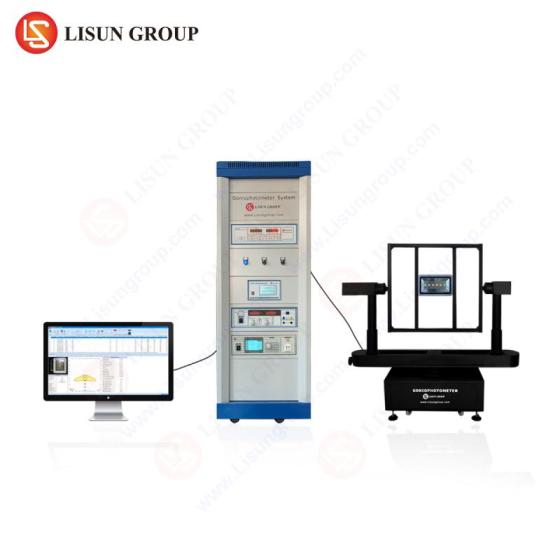
LSG-1890B/LSG-1800A goniophotometer is automatic goniophotometric instrument for luminous intensity distribution measurements with facility for rotating the light source. The LSG-1890B/LSG-1800A uses a constant temperature detector, Japanese motor and German precision angle coder which keep the test results with high accuracy. It is for industrial laboratory photometric data measurement of all kinds of luminaries such as LED luminaries, HID lamps, fluorescent lamps and so on.
High Precision Rotation Luminaire Goniophotometer
Standard:
Full meet the EN13032-1 clause 6.1.1.3 goniophotometer type 1, COMMISSION DELEGATED REGULATION (EU) 2019/2015, CIE-70, CIE-121, IES LM-79, IES LM-75, IES LM-80 and ect.
Measurement:Luminous Intensity Data, Luminous Intensity Distribution, Zonal Luminous Flux, Luminaries Efficiency(Option),Luminance Distribution,Coefficient Of Utilization, Luminance Limitation Curves Glare, Maximum Ratio of Distance to Height, Equal Illuminance Diagrams, Curves of Luminaires VS Lighting Area, Isocandela Diagrams, Efficient Luminescence Angle, EEI, UGR, etc.
| LISUN Model | The Max Size for the Luminaires under Test (Diameter*Depth) | Max Weight |
| LSG-1890B | Φ 2000*600 (Diameter*Depth) | 60Kg |
| LSG-1800A | Φ 1600*600 (Diameter*Depth) | 50Kg |
Product Specifications
- Product Date 2026
- Delivery cycle within 1 month
- Customize Support
- Price Quotation
- Exit Support
- OEM Quotation
- Supplier Lisun Instruments Limited
- Delivery Method Land transport/Ocean transport, etc.
- User Manual provide
- Shippable Areas Southeast Asia and Global
Procurement Recommendation
Selecting a high-precision goniophotometer for full spatial photometric testing requires careful evaluation of mechanical stability, angular resolution, and detector calibration. The system should comply with CIE S 025/E:2015 and IES LM-79 standards, offering ±0.1° angular accuracy and a dynamic range capable of measuring both low-lumen decorative fixtures and high-output industrial luminaires. Key features include dual-axis rotation (Type A, B, or C per CIE classification), temperature-controlled mounting to simulate real-world thermal behavior, and a spectroradiometer with NIST-traceable calibration for accurate CCT, CRI, and luminous flux data. Suppliers should provide full uncertainty budgets, regular recalibration services, and software compatible with common lighting design platforms (e.g., AGi32, Dialux). Ideal applications include R&D validation, energy efficiency certification (ENERGY STAR, DLC), and compliance testing for global markets (EU Ecodesign, California Title 20). Ensure the chamber size accommodates your largest fixture and that stray light is minimized through baffled optical paths. Prefer vendors offering on-site installation, operator training, and integration with automated test sequences to enhance repeatability. Long-term reliability hinges on robust bearing systems and environmental shielding against vibration or ambient light interference. (for reference only)
Due to market conditions, product updates, and policy changes, please contact the supplier for the latest information.

Feedback & reviews


Comments